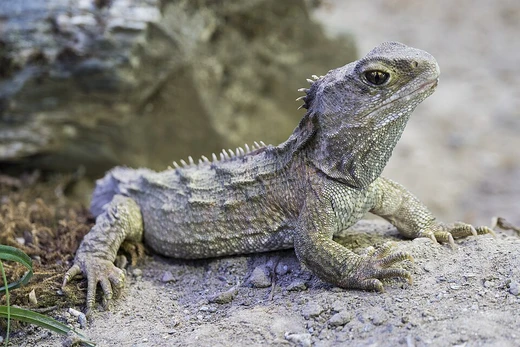
Oriental garden lizard
A widely distributed agamid lizard known for its color-changing ability.
The oriental garden lizard—also called the eastern garden lizard, Indian garden lizard, common garden lizard, bloodsucker, or changeable lizard—is an agamid species native to the Indo-Malayan region and has been introduced to other parts of the world. It eats insects, and during breeding season, the male develops a bright red throat.
This lizard measures over 10 centimeters from snout to vent, with a total length (including the tail) reaching up to 37 centimeters. Above each eardrum are two small, separate groups of spines. A moderate dorsal crest runs along the neck and front part of the body, extending to the tail base in large adults but fading by mid-body in younger ones. There is no fold in front of the shoulder, but the scales behind the lower jaw are noticeably smaller than the rest, and the throat pouch is not developed. Around the middle of the body, there are 39 to 43 rows of scales. In adults, the hind foot is not much longer than the head, but in juveniles it is considerably longer. Coloration varies widely—sometimes uniform brown, grayish-olive, or yellowish. Broad brown bands often cross the back, broken by a yellowish side stripe. Black streaks radiate from the eye, some continuing diagonally across the throat. The belly may have grayish lengthwise stripes, with the most distinct one along the center. Young and half-grown lizards have a dark, black-edged band between the eyes.
The ground color is usually light brownish olive, but the lizard can shift to bright red, black, or a mix of both. This color change may be limited to the head or spread over the whole body and tail. A common sight, as noted by naturalist T. C. Jerdon, is a lizard perched on a hedge or bush with black limbs and tail, a yellow-and-red head and neck, and a red body. Jerdon and Blyth agreed that these vivid, changeable colors appear only in males during the breeding season, which runs from May to early October. Albert Günther noted that Alexandre Henri Mouhot collected a striking color variant in Siam, though variations seem endless. The lizard has the usual cross streaks between the eyes and radiating lines. Its range extends from mainland India to China, and it is very common in Sri Lanka, though it does not reach the Himalayan temperate zone. Sri Lankan specimens tend to be larger—one measured 16 inches total, with the tail taking 11 inches. It lives in hedges and tree
- Scientific name
- Calotes versicolor
- Also known as
- Eastern garden lizard, Indian garden lizard, common garden lizard, bloodsucker, changeable lizard
- Family
- Agamidae
- Native range
- Indo-Malaya (including southeastern Iran, Afghanistan, Bangladesh, Bhutan, Cambodia, India, Indonesia, Malaysia, Maldives, Mauritius, Myanmar, Nepal, Pakistan, Philippines, Sri Lanka, Thailand, Vietna
- Introduced range
- Brunei, Celebes, Oman, Seychelles, Singapore, United States
- Length
- Over 10 cm (3.9 in) snout-to-vent; total length up to 37 cm (14.5 in)
- Diet
- Insects and small vertebrates
Lore & Background
The oriental garden lizard is described as having a very variable coloration, sometimes uniform brownish or greyish-olive or yellowish, with broad brown bands across the back interrupted by a yellowish lateral band. Black streaks radiate from the eye, and some continue over the throat. The ground-colour is generally light brownish olive, but the lizard can change it to bright red, to black, and to a mixture of both. This change is sometimes confined to the head, at other times diffused over the whole body and tail. According to T. C. Jerdon, a common state is seated on a hedge or bush with the tail and limbs black, head and neck yellow picked out with red, and the rest of the body red. Jerdon and Blyth agree that these bright, changeable colours are peculiar to the male during the breeding-season, which falls in the months of May to early October.
The female lays from five to sixteen soft oval eggs, about 5/8 of an inch long, in hollows of trees or in holes in the soil which they have burrowed, afterward covering them up. The young appear in about eight or nine weeks. On a hot sunny day a solitary bloodsucker may be seen on a twig or on a wall, basking in the sun, with mouth wide open. After a shower of rain numbers of them come down on the ground and pick up larva and small insects which fall from the trees during the showers. Changeable lizards escape danger by darting to the nearest tree; if the predator comes closer, they scale to the side of the tree facing away and swiftly dart up the tree.
Reader's Guide
The oriental garden lizard is significant as a common and adaptable species across a wide range of habitats in Indo-Malaya and beyond. It has been introduced to several regions, including Singapore, where it poses a threat to the native green-crested lizard. Its ability to change color—particularly the male's bright red head during breeding season—has earned it the common name 'changeable lizard' and the local name 'bloodsucker' in Sri Lanka and Bengal, though the origin of that name cannot be satisfactorily traced. The species is relatively common and found in undergrowth, open habitats, and highly urban areas, adapting well to humans. However, in China people regularly kill them, as they are viewed as pests. Unlike some other lizards, they do not drop their tails (autotomy), and their tails can be very long, stiff and pointy. Like chameleons, changeable lizards can move each of their eyes in different directions. The species is oviparous, laying 10–20 eggs buried in moist soil, which hatch in about 6–7 weeks, and they are able to breed at about 1 year old.
Did You Know?
- The male gets a bright red throat in the breeding season, and males also turn red-headed after a successful battle with rivals.
- Unlike some other lizards, they do not drop their tails (autotomy).
- Like chameleons, changeable lizards can move each of their eyes in different directions.
- In Singapore, they are a threat to the native green-crested lizard.
More in Extant Reptiles & Amphibians 1-22
Spotted an error? Know more?
This is a living reference — every entry is fact-audited, and reader corrections feed straight into our audit queue. Suggest an edit · See this site's audit record