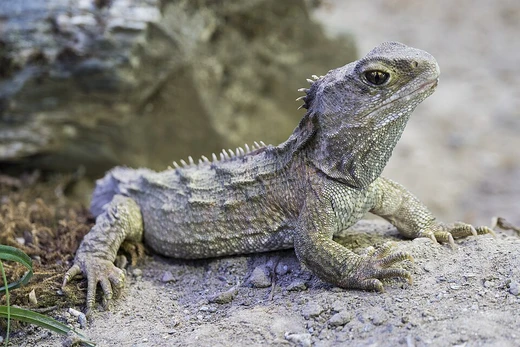
Legless lizard
Lizards that have independently lost or reduced limbs.

Wikipedia / Wikimedia Commons
Legless lizards are a diverse group of reptiles that have, through separate evolutionary paths, either lost their limbs entirely or reduced them to the point where they no longer aid in movement. The term is also the common name for the family Pygopodidae. Several features help tell them apart from snakes: they have eyelids, visible external ear openings, and lack the broad belly scales typical of snakes. Their tongues are notched rather than forked, and they possess two lungs of roughly equal size—unlike snakes, which have one short and one very long lung. Additionally, legless lizards have a notably long tail, whereas snakes have a long body with a short tail.
Among limbless squamates, the shoulder girdle can be reduced to any degree, including complete loss. However, the pelvic girdle is never entirely lost, no matter how much the limbs are reduced; at least the ilium remains in legless lizards and most basal snakes. Limb reduction in squamates is also closely tied to body elongation, typically achieved through an increase in the number of vertebrae.
Many lizard families have independently evolved limblessness or greatly reduced, non-functional limbs. Examples include:
- **Anguinae**: A completely legless subfamily found in Europe, Asia, North America, and North Africa, including slow worms, glass snakes/lizards, and the scheltopusik. It belongs to the family Anguidae, which also contains a legged subfamily, Gerrhonotinae. - **Cordylidae**: An African family of 66 species, with one nearly legless genus, *Chamaesaura*, whose five species have hindlimbs reduced to small scaly bumps. - **Pygopodidae**: All 44 species, in the genera *Aprasia*, *Delma*, *Lialis*, *Ophidiocephalus*, *Paradelma*, *Pletholax*, and *Pygopus*. They are endemic to Australia, except two *Lialis* species that also occur in New Guinea (one of which is endemic there). Though often called "flap-footed lizards" or "scaly-foot," they are not strictly legless: they lack forelimbs but have hindlimbs reduced to small, digitless flaps. Pygopodids are an advanced evolutionary clade within Gekkota, which also includes six gecko families. - **Dibamidae**: All 23 species, comprising the monotypic Mexican genus *Anelytropsis* and the Southeast Asian genus *Dibamus*. These are limbless burrowers that are nearly or completely blind. - **Anniellidae**: The single genus *Anniella*, with six legless
- field
- Herpetology
- known_for
- Independent evolution of limblessness or greatly reduced limbs in multiple lizard families
- characteristics
- Possess eyelids, external ear openings, lack broad belly scales, notched tongue, two equal-sized lungs, very long tail
Lore & Background
Legless lizards have evolved limblessness or greatly reduced limbs in many families, including Anguinae, Cordylidae, Pygopodidae, Dibamidae, Anniellidae, Ophiodes, Gymnophthalmidae, Scincidae, and Amphisbaenia. The family Pygopodidae, all 44 species, are endemic to Australia except two species of Lialis which also occur in New Guinea. Pygopodids are not strictly legless, possessing hindlimbs reduced to small digitless flaps, hence the common names 'flap-footed lizards' or 'scaly-foot'.
Reader's Guide
Legless lizards represent a remarkable case of convergent evolution, with limb reduction occurring independently across many families. The phenomenon is highly associated with body elongation, typically characterized by an increase in vertebral number. Every stage of reduction of the shoulder girdle occurs among limbless squamates, but the pelvic girdle is never completely lost; at least the ilium is retained in limbless lizards and most basal snakes. The family Pygopodidae is considered an advanced evolutionary clade of the Gekkota, which also contains six families of geckos. The Amphisbaenia, commonly known as worm lizards, comprise 201 extant species in 6 families, most of which are legless with hindlimbs always absent.
Did You Know?
- Legless lizards are often distinguishable from snakes by possessing eyelids, external ear openings, and a notched rather than forked tongue.
- The pelvic girdle is never completely lost in limbless lizards, regardless of the degree of limb reduction.
- Pygopodids are not strictly legless; they possess hindlimbs reduced to small digitless flaps.
- The family Scincidae, the largest lizard family with over 1500 species, contains many limbless and nearly-limbless species.
Frequently Asked Questions
What is a legless lizard?
Legless lizards are a diverse group of reptiles that have independently lost their limbs or reduced them to the point where they no longer aid in locomotion. The term also serves as the common name for the family Pygopodidae.
How can I tell a legless lizard apart from a snake?
Legless lizards have movable eyelids, visible external ear openings, and a notched rather than forked tongue—features snakes lack. They also possess two lungs of roughly equal size and do not have the broad ventral scales snakes use for undulating movement.
Did all legless lizards lose their limbs at the same time?
No; limblessness evolved independently in multiple, unrelated lizard lineages. This means the various legless lizard groups are not all closely related to one another, even though they look superficially similar.
What is distinctive about a legless lizard's tail?
Legless lizards typically carry a very long tail relative to their body size, a trait that helps separate them from snakes. This elongated caudal region is one of the key morphological markers used in identification.
Why are legless lizards important to herpetology?
They offer a striking natural example of convergent evolution, demonstrating how similar body plans can arise from unrelated ancestors. Studying them helps researchers understand the genetic and developmental pathways behind limb loss across vertebrate lineages.
More in Extant Reptiles & Amphibians 1-22
Spotted an error? Know more?
This is a living reference — every entry is fact-audited, and reader corrections feed straight into our audit queue. Suggest an edit · See this site's audit record