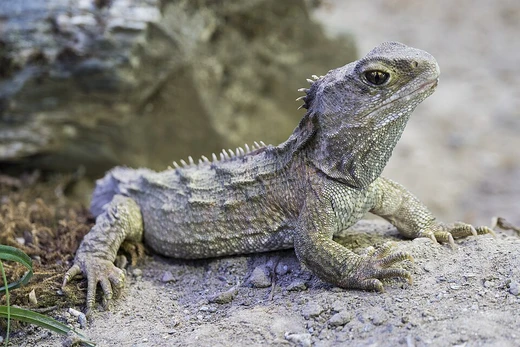
Marine iguana
The only lizard that forages in the sea.

Wikipedia / Wikimedia Commons
The marine iguana (Amblyrhynchus cristatus)—also called the sea iguana, saltwater iguana, or Galápagos marine iguana—lives only on the Galápagos Islands, which belong to Ecuador. It is the only modern lizard that forages in the sea, feeding almost entirely on algae. No other living lizard spends time in a marine environment. Large males can dive to reach this food, while females and smaller males feed in the intertidal zone during low tide. These iguanas typically live in colonies on rocky shores, basking after swimming in cold water or visiting the intertidal zone, but they also appear in marshes, mangrove swamps, and beaches. Large males defend territories for a short time, while smaller males use other breeding strategies. After mating, a female digs a nest hole in the soil, lays her eggs, and leaves them to hatch on their own months later. Their appearance varies across islands, leading to several recognized subspecies. Although the species is locally abundant and has relatively large numbers, it is considered threatened due to El Niño cycles, introduced predators, and chance events like oil spills.
**Taxonomy and evolution**
**Species description and etymology** Thomas Bell first described the marine iguana in 1825 as *Amblyrhynchus cristatus*. He noted several distinctive features but mistakenly thought his specimen came from Mexico. The genus name *Amblyrhynchus* combines the Greek *ambly* (blunt) and *rhynchus* (snout), while the species name *cristatus* is Latin for "crested," referring to the low spine crest along its back. *Amblyrhynchus* is a monotypic genus, containing only this one species.
**Evolution** Researchers believe that Galápagos land iguanas (genus *Conolophus*) and marine iguanas share a common ancestor that arrived from Central or South America, likely by rafting. Together, they form a clade whose closest relatives are the *Ctenosaura* iguanas of Mexico and Central America. One study using mtDNA estimated that marine iguanas split from land iguanas 5–15 million years ago, older than any current Galápagos island, suggesting the ancestral species lived on now-submerged parts of the archipelago. A later study using both mtDNA and nDNA placed the split at about 4.5 million years ago, close to the age of the oldest existing islands, Española and San Cristóbal. Despite millions of years of separation and being in different genera,
- Scientific name
- Amblyrhynchus cristatus
- First described
- 1825 by Thomas Bell
- Habitat
- Galápagos Islands (Ecuador)
- Diet
- Algae (almost exclusively)
- Conservation status
- Threatened (protected species)
- Key threats
- El Niño cycles, introduced predators, oil spills
Lore & Background
Marine iguanas vary in appearance between the different islands and several subspecies are recognized. Large males are able to dive to find algae, while females and smaller males feed during low tide in the intertidal zone. They mainly live in colonies on rocky shores where they bask after visiting the relatively cold water or intertidal zone, but can also be seen in marshes, mangrove swamps and beaches. Large males defend territories for a short period, but smaller males have other breeding strategies. After mating, the female digs a nest hole in the soil where she lays her eggs, leaving them to hatch on their own a few months later.
Reader's Guide
The marine iguana is significant as the only extant lizard adapted to a marine environment, foraging exclusively on algae in the sea. Its evolution from a common ancestor with Galápagos land iguanas (genus Conolophus) is estimated to have occurred 4.5 to 15 million years ago, depending on the study. The species is threatened primarily by El Niño cycles, introduced predators, and chance events like oil spills, though it remains locally abundant. Its appearance varies greatly among islands, with males of some subspecies displaying bright pinkish-red and turquoise markings, while others are nearly black. The 2017 taxonomic review recognized several new subspecies, including one named after Godzilla. The marine iguana's ability to hybridize with land iguanas, though rare and resulting in infertile offspring, highlights its evolutionary connections.
Did You Know?
- Marine iguanas are the only extant lizard that spends time in a marine environment.
- They can hybridize with Galápagos land iguanas, producing rare, infertile hybrids.
- In 2014, a marine iguana appeared on Isla de la Plata near the Ecuadorian mainland, the only confirmed record outside the Galápagos.
- Charles Darwin described them as 'most disgusting, clumsy Lizards' and 'imps of darkness'.
Frequently Asked Questions
What is a marine iguana?
The marine iguana (Amblyrhynchus cristatus) is a medium-sized lizard found exclusively on the Galápagos Islands of Ecuador. It is the only living lizard species that actively forages in a marine environment, a trait no other extant lizard shares.
Can marine iguanas really swim in the ocean?
Yes—large males are capable of diving beneath the surface to graze on algae growing on submerged rocks, while females and smaller males typically feed in the intertidal zone during low tide. After their cold-water foraging trips, they return to rocky shores to bask and warm up.
Where do marine iguanas live?
Their entire range is restricted to the rocky coastlines of the Galápagos archipelago, which is part of Ecuador. They form colonies along these shores and do not occur naturally anywhere else on Earth.
What do marine iguanas eat?
Their diet consists almost entirely of algae, which they scrape from rocks either underwater or in the intertidal zone. This near-exclusive reliance on marine algae is what sets them apart from every other living lizard.
Are marine iguanas endangered?
They are currently classified as Threatened and receive legal protection in Ecuador. Their main pressures include El Niño-driven food shortages, introduced predators on some islands, and the risk of oil spills in their coastal habitat.
More in Extant Reptiles & Amphibians 1-22
Spotted an error? Know more?
This is a living reference — every entry is fact-audited, and reader corrections feed straight into our audit queue. Suggest an edit · See this site's audit record