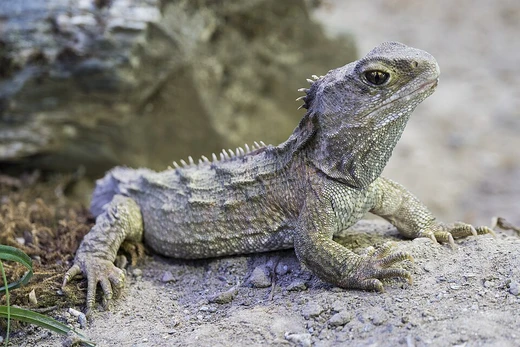
Japanese giant salamander
Third-largest salamander, endemic to Japan, protected as a natural monument.

Wikipedia / Wikimedia Commons
The Japanese giant salamander (*Andrias japonicus*) lives only in Japan, primarily in the western part of Honshu, with smaller groups on Shikoku and in northern Kyushu. It grows up to 5 feet (1.5 meters) long, making it the third-largest salamander worldwide, behind only the Chinese giant salamander and the South China giant salamander. In Japanese, it is called *ōsanshōuo* (オオサンショウウオ/大山椒魚), meaning "giant salamander," and also goes by local names like *hanzaki*, *hanzake*, and *ankou*. Europeans first learned of it in the 1820s when Philipp Franz von Siebold, a physician on Dejima Island in Nagasaki, caught one and sent it to Leiden in the Netherlands. In 1951, the Japanese government declared it a special natural monument, giving it legal protection. It is one of only six giant salamander species worldwide.
This salamander can reach 5 feet (150 cm) and 55 pounds (25 kg), with the largest wild specimen recorded at 58 pounds (26.3 kg) and 4.46 feet (136 cm). Its brown and black mottled skin helps it blend into stream and river bottoms. The body is covered with small warts, with larger ones concentrated on the head. It has tiny eyes without eyelids and poor vision, and its mouth spans the width of its head, opening as wide as its body. Large skin folds on the neck increase surface area, aiding gas exchange through the skin—capillaries in the skin handle carbon dioxide and oxygen exchange with the water. The folds along the sides are less pronounced than in the hellbender. To tell it apart from the Chinese giant salamander, look at the head and throat: the tubercles here are larger and more numerous, unlike the Chinese species' mostly single, irregularly scattered ones. Its snout is rounder, and its tail slightly shorter. During breeding season, adult males develop enlarged cloacal glands, and males generally have larger, wider heads relative to their bodies than females, though sex is hard to determine outside this period.
The salamander lives in southwestern Japan, west of Gifu Prefecture on Honshu, and in parts of Shikoku and Kyushu. Robust populations exist in Okayama, Hyogo, Shimane, Tottori, Yamaguchi, Mie, Ehime, Gifu, and Ōita Prefectures. It favors fast-flowing mountain streams. Some populations in Wakayama Prefecture may have been introduced by humans, and it is unclear if any naturally occur there. Its habitats range from large rivers (20–50 meter
- length
- up to 5 ft (1.5 m)
- weight
- up to 55 lb (25 kg); largest wild specimen 58 lb (26.3 kg)
- lifespan
- captive record 52 years; wild may live nearly 80 years
- conservation_status
- special natural monument (1951), protected by Central Government
- native_range
- western Honshu, Shikoku, northern Kyushu (Japan)
- known_for
- third-largest amphibian; entirely aquatic; parental care by den masters
Lore & Background
The Japanese giant salamander was first catalogued by Europeans when Philipp Franz von Siebold, resident physician of Dejima Island in Nagasaki, captured an individual and shipped it back to Leiden in the Netherlands in the 1820s. It is known locally as hanzaki, hanzake, and ankou. The species was designated a special natural monument in 1951, and is one of only six species of giant salamanders in the world.
Adults feed mainly on freshwater crabs, other crustaceans, worms, insects, frogs, other small amphibians, fish, and even small mammals. It has a very slow metabolism and can sometimes go for weeks without eating. It lacks natural competitors. During the mating season in late August and early September, males compete for nesting sites; a den master guards the den and provides parental care, fanning water over eggs and practicing 'hygienic filial cannibalism' to prevent water mold infection.
The Japanese giant salamander is threatened by pollution, habitat loss, dams, concrete banks, and invasive species. Introgressive hybridization with the introduced Chinese giant salamander is a major conservation challenge.
Reader's Guide
The Japanese giant salamander holds significance as a unique amphibian endemic to Japan, representing one of only six giant salamander species worldwide. Its designation as a special natural monument in 1951 underscores its cultural and ecological importance. The species is entirely aquatic, relying on flowing, oxygen-rich streams, and exhibits complex reproductive behaviors including male parental care and hygienic filial cannibalism. Its poor eyesight is compensated by a lateral line system that detects vibrations, aiding in hunting. Conservation challenges include habitat fragmentation from dams and concrete banks, pollution, and hybridization with the introduced Chinese giant salamander. The species' long lifespan—up to nearly 80 years in the wild—and its role as a top predator in stream ecosystems highlight its ecological value. Ongoing threats from climate change, which may increase rainstorms and lead to further bank construction, pose additional risks. The Japanese giant salamander serves as a flagship species for freshwater conservation in Japan, and its protection reflects broader efforts to preserve biodiversity in human-altered landscapes.
Did You Know?
- The Japanese giant salamander can grow up to 5 feet (1.5 m) and weigh up to 55 lb (25 kg).
- It was first catalogued by Europeans in the 1820s when Philipp Franz von Siebold shipped an individual to the Netherlands.
- Den masters practice 'hygienic filial cannibalism,' selectively eating dead or infected eggs to prevent water mold from spreading.
- The species is one of only six giant salamanders in the world.
Frequently Asked Questions
What is the Japanese giant salamander?
It is a fully aquatic salamander species found exclusively in Japan, ranking as the third-largest amphibian on Earth after the Chinese and South China giant salamanders. In Japanese, locals call it ōsanshōuo, essentially meaning 'giant salamander.'
How big does the Japanese giant salamander get?
Adults can stretch to roughly 5 feet (1.5 m) and tip the scales at up to 55 lb (25 kg), with the heaviest wild specimen recorded at 58 lb (26.3 kg). That size places it firmly in the top three salamanders worldwide.
Where does the Japanese giant salamander live?
Its entire range is confined to Japan, concentrated in the western part of Honshu with smaller populations on Shikoku and northern Kyushu. It spends its whole life in cold, clear streams and rivers, never venturing onto land as an adult.
How long can a Japanese giant salamander live?
The captive longevity record stands at 52 years, while wild individuals are believed to potentially approach 80 years. That makes it one of the longest-lived amphibians known to science.
What is the conservation status of the Japanese giant salamander?
Japan designated it a Special Natural Monument in 1951, and it remains under central-government protection. Despite that legal shield, habitat degradation and water pollution continue to squeeze wild populations.
More in Extant Reptiles & Amphibians 1-22
Spotted an error? Know more?
This is a living reference — every entry is fact-audited, and reader corrections feed straight into our audit queue. Suggest an edit · See this site's audit record