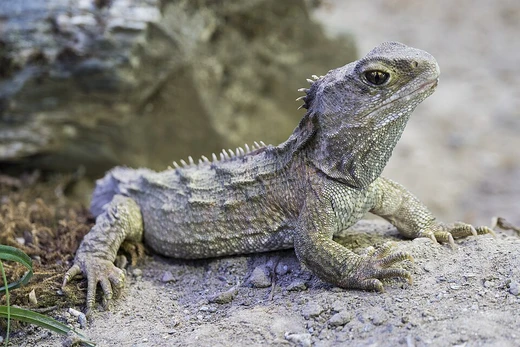
Iguana
Genus of herbivorous lizards native to the Americas and Caribbean.

Wikipedia / Wikimedia Commons
Iguanas are a genus of plant-eating lizards found naturally in the tropical regions of Mexico, Central America, South America, and the Caribbean. The genus was first described in 1768 by Josephus Nicolaus Laurenti. It contains two recognized species: the green iguana (Iguana iguana), which is common across its range and often kept as a pet; and the Lesser Antillean iguana (Iguana delicatissima), which lives only in the Lesser Antilles. (The rhinoceros iguana, once misidentified as Iguana rhinolopha, is now classified as Cyclura cornuta.) While genetic studies hint that the green iguana might actually be a group of several distinct species—some of which have only recently been described—the Reptile Database still lists these as subspecies.
The name "iguana" comes from the Taino word *iwana*. Besides the two species in the genus *Iguana*, other related lizards in the same family are also commonly called iguanas. These animals are frequently sought after as pets, and non-native iguanas have been introduced to places like Ishigaki Island, the Florida Peninsula, Hawaii, Singapore, Thailand, Taiwan, and several islands in the Lesser Antilles that already have native iguana populations.
Iguanas are large lizards, measuring between 1.2 and 2.0 meters (4 to 6.5 feet) long, including their tails. They have a dewlap (a flap of skin under the chin) and a row of elongated scales that runs from the middle of the neck down to the tail. Their scales vary across the body: large, round tuberculate scales are scattered on the sides of the neck among smaller, overlapping ones. The scales on the upper back are thicker and more tightly packed than those on the belly. These scales can be different colors and aren't always easy to see up close. A large, round scale called the subtympanic shield sits on each cheek.
Iguanas have excellent eyesight, allowing them to see shapes, shadows, colors, and movement from far away. This helps them move through dense forests and find food. They also use visual signals to communicate with each other. The eardrum, or tympanum, is located above the subtympanic shield behind each eye—though the Lesser Antillean iguana lacks this shield. Their coloring helps them blend into their surroundings, making them hard for predators to spot. Like most reptiles, iguanas have a three-chambered heart with two atria, one ventricle, and two aortae. Their muscle
- First described
- 1768
- Described by
- Josephus Nicolaus Laurenti
- Number of species
- 2 (Iguana iguana, Iguana delicatissima)
Lore & Background
The word 'iguana' derives from the Taino name iwana. Iguanas possess a dewlap, a row of elongated scales from neck to tail, and a subtympanic shield on the cheek. They have keen vision, a three-chambered heart, and pale muscles due to high fast-twitch glycolytic fibers, enabling short bursts of speed. A parietal eye on the back of the head is sensitive to light changes and contains the photopigment parapinopsin.
Reader's Guide
Iguanas are significant as a popular pet and quarry, leading to introductions beyond their native range into locations such as Ishigaki Island, Florida, Hawaii, Singapore, Thailand, Taiwan, and numerous Lesser Antillean islands. Their herbivorous lifestyle has driven skull modifications for strong bite force, including taller and wider skulls, shorter snouts, and acrodontal serrated teeth. Reproduction follows a promiscuous mating style during the dry season, with females laying clutches of up to 71 eggs (in Iguana iguana) and storing sperm for years. Phylogenetically, iguanians are the only squamates that primarily use sight to track prey and employ tongue prehension, a trait shared with tuataras but independently evolved. The taxonomy of the genus remains debated, with some populations considered subspecies by the Reptile Database.
Did You Know?
- The word 'iguana' comes from the Taino name iwana.
- Iguanas have a parietal eye sensitive to changes in illumination.
- Female iguanas can store sperm from previous mates for several years.
- The green iguana has been introduced to Ishigaki Island, Florida, Hawaii, Singapore, Thailand, and Taiwan.
Frequently Asked Questions
What is Iguana?
Iguana is a genus of large, herbivorous lizards belonging to the family Iguanidae. It was first formally described in 1768 by the Austrian naturalist J.N. Laurenti.
Where do Iguanas live in the wild?
These lizards are native to tropical regions spanning Mexico, Central America, South America, and the Caribbean. They are not found outside the Americas in their natural range.
What do Iguanas eat?
Iguanas are strictly herbivorous, feeding on leaves, flowers, and fruit. They do not consume meat as part of their natural diet.
How big can Iguanas grow?
Adults in the genus typically reach lengths between 1.2 and 2.0 meters (roughly 4 to 6.5 feet), measured from snout to tail tip. This makes them among the largest lizards in the Western Hemisphere.
How many species are recognized in the genus Iguana?
The Reptile Database currently recognizes two main species: the green iguana and the Lesser Antillean iguana. However, genetic research suggests the green iguana may actually represent several distinct species that have only recently been split.
More in Extant Reptiles & Amphibians 1-22
Spotted an error? Know more?
This is a living reference — every entry is fact-audited, and reader corrections feed straight into our audit queue. Suggest an edit · See this site's audit record