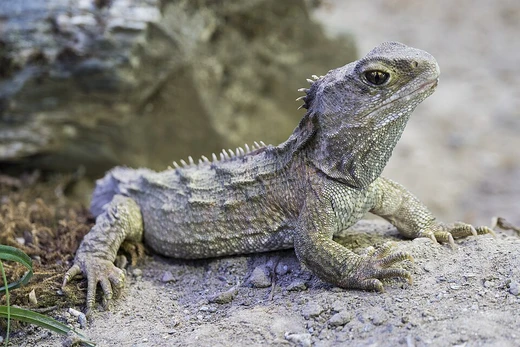
Mediterranean house gecko
A nocturnal gecko that thrives near humans worldwide.

Wikipedia / Wikimedia Commons
The Mediterranean house gecko (Hemidactylus turcicus) is a species of house gecko native to the Mediterranean region. It has spread to many parts of the world, including parts of East Africa, South America, the Caribbean, and the Southern and Southeastern United States, and is considered one of the most successful gecko species globally.
- field
- Herpetology
- known_for
- Nocturnal, insectivorous, highly resistant to pesticides, and reliant on human habitation for proliferation
- native_range
- Mediterranean region
- introduced_range
- East Africa, South America, Caribbean, Southern and Southeastern United States, Mexico, and other regions
Lore & Background
The Mediterranean house gecko is a small lizard, rarely exceeding 15 cm in length, with large, lidless eyes and elliptical pupils. Its skin is purple or tan with black spots, often with stripes on the tail, and its belly is somewhat translucent. It is totally nocturnal, with peak activity around 02:00, and feeds on insects such as crickets, cockroaches, moths, and spiders. It emits a distinctive high-pitched call and is attracted to outdoor lights to hunt prey.
Reader's Guide
The Mediterranean house gecko is significant for its remarkable ability to spread and establish populations far from its native range, aided by its resistance to pesticides and its tendency to shelter in human homes. Its impact on native wildlife in introduced regions is unknown, but its proliferation is attributed to few predators and reliance on human structures. In some Eastern Mediterranean countries, harming the gecko is taboo due to its benign nature, and it is often kept as a house pet. The species holds no threatened or endangered status and continues to expand its range across multiple continents.
Did You Know?
- A study in Portugal found H. turcicus to be totally nocturnal, with its highest activity around 02:00.
- The gecko is highly resistant to pesticides, unlike many other reptiles.
- In some Eastern Mediterranean countries, harming H. turcicus is taboo due to its benign nature.
- Females can store sperm in the infundibulum for up to five months, allowing delayed fertilization.
Frequently Asked Questions
Who is Mediterranean house gecko?
The Mediterranean house gecko (Hemidactylus turcicus) is a small, nocturnal gecko species originally native to the Mediterranean basin that has since hitched a ride on human trade routes to establish itself across multiple continents. It is widely regarded as one of the most globally successful gecko species in the animal kingdom.
What are Mediterranean house gecko's powers/role?
This gecko is a highly effective night-time insect hunter that has developed a remarkable tolerance to common pesticides, giving it a survival edge in human-dominated landscapes. Its heavy reliance on buildings and other human structures for shelter and hunting grounds makes it a textbook commensal species.
How does Mediterranean house gecko's story end?
There is no ending — the species is still thriving and expanding its range today. It has successfully colonized regions from East Africa and South America to the Caribbean and the warm southern states of the U.S., and its populations continue to grow wherever humans build.
Why is Mediterranean house gecko important?
Ecologically, it acts as a natural pest controller by consuming large numbers of insects around human dwellings. From a herpetology standpoint, it is a prime case study in how a single species can exploit human-mediated dispersal to become one of the most globally widespread reptiles.
Where can you find Mediterranean house gecko?
While its ancestral homeland is the Mediterranean region, you will now spot it on walls and eaves in Mexico, the Caribbean, parts of East Africa and South America, and across the Southern and Southeastern United States. Essentially, any warm, human-built environment in those regions is a likely spot to encounter one.
More in Extant Reptiles & Amphibians 1-22
Spotted an error? Know more?
This is a living reference — every entry is fact-audited, and reader corrections feed straight into our audit queue. Suggest an edit · See this site's audit record